What is a Trunnion Ball Valve?
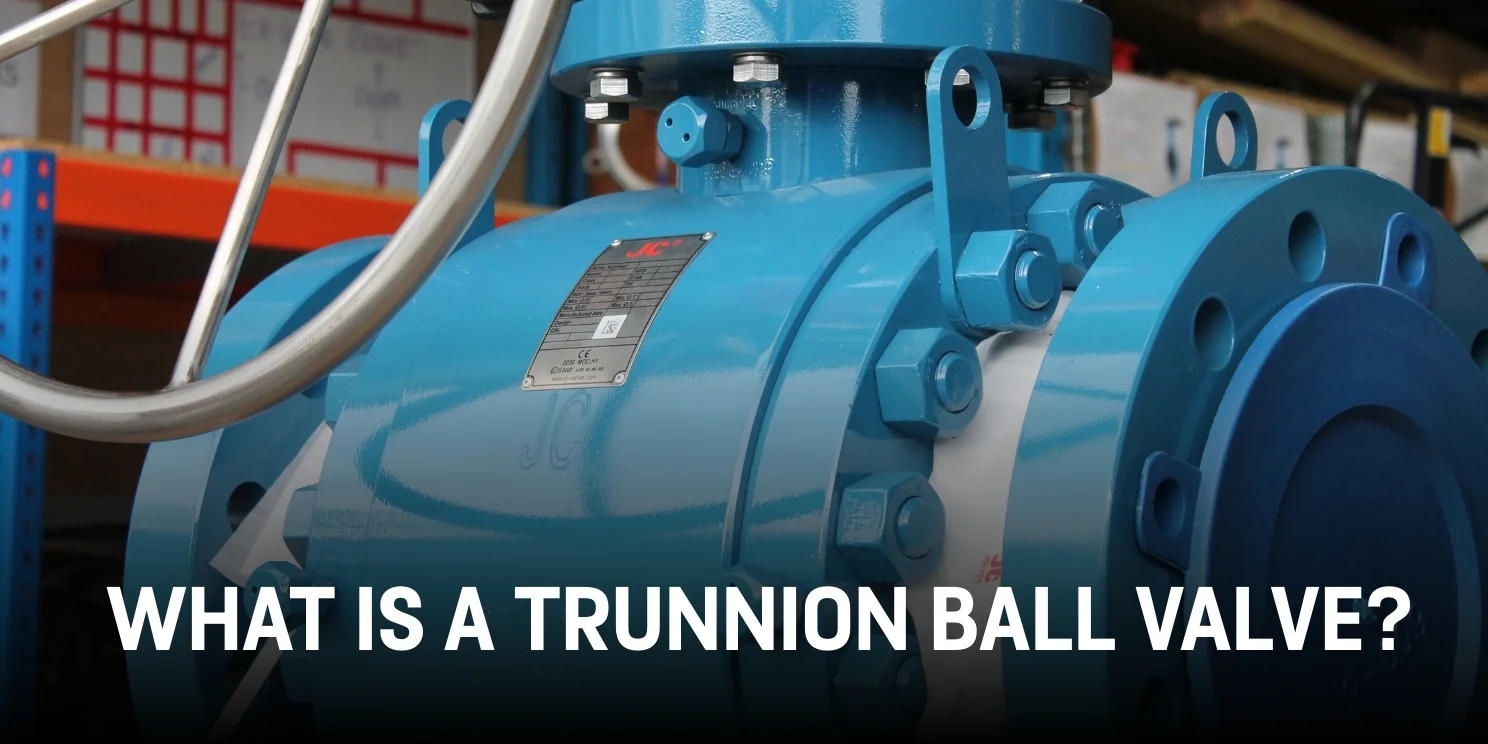
In the world of flow control, the ball valve is king, but the Trunnion Mounted Ball Valve is its most robust evolution.
Unlike standard valves where the ball is held only by two seats, a trunnion valve secures the ball at both the top and the bottom. This additional mechanical anchoring—the "trunnion"—is what allows these valves to handle extreme pressures (up to Class 2500) and large sizes (up to 60 inches) without compromising the seal or requiring massive actuators.
Trunnion vs. Floating: The Critical Difference
The fundamental difference between valve types lies in how they handle pressure.
In a Floating Ball Valve, the ball is slightly pushed by the upstream pressure into the downstream seat to create a seal. However, at high pressures or in large pipe diameters, this force becomes so great that it can damage the seats or make the valve impossible to turn.
A Trunnion Ball Valve solves this by keeping the ball in a fixed position. Instead of the ball moving toward the seat, the seats move toward the ball. These seats are spring-loaded, ensuring a tight seal even at low pressure, while the trunnion absorbs the massive hydraulic thrust of the pipeline, preventing seat deformation.
Anatomy of a Trunnion Valve: Built for Durability
A high-performance trunnion valve is a complex assembly of precision-engineered parts. The core components include:
-
The Trunnion Plate/Stem: The heavy-duty anchor at the bottom of the ball that prevents lateral movement.
-
Spring-Loaded Seats: These provide a constant "pre-load" against the ball.
-
Blow-out Proof Stem: An essential safety feature where the stem is designed with a shoulder to prevent it from being ejected under pressure.
-
Sealant Injection Fittings: Most API 6D trunnion valves include ports to inject emergency sealant if the primary seats are damaged by debris.
Sealing Mechanisms: Understanding SPE and DPE
One of the most technical advantages of trunnion valves is the ability to choose the seating logic.
-
Single Piston Effect (SPE): Also known as "Self-Relieving" seats. If the pressure inside the valve body cavity exceeds the pipeline pressure, the seats are pushed away, allowing the pressure to bleed back into the line.
-
Double Piston Effect (DPE): These seats provide a "Double Block and Bleed" (DBB) capability. No matter where the pressure comes from (the line or the cavity), the seats are pushed against the ball. This is critical for high-safety applications where a leak could be catastrophic.
Why Engineers Choose Trunnion Designs
The move from a floating valve to a trunnion design is usually driven by three factors:
-
Reduced Operating Torque: Because the ball is anchored, the friction against the seats is significantly lower. This allows for smaller, cheaper actuators.
-
Extended Seat Life: Since the ball doesn't "smash" into the downstream seat every time the pressure spikes, the polymer or metal seats last much longer.
-
Fire-Safe Design: Most trunnion valves are designed to API 607 standards, meaning if the soft seats melt in a fire, a secondary metal-to-metal seal takes over to prevent the fire from being fed by the pipeline media.
Primary Applications: Where Only a Trunnion Will Do
Because of their reliability and size range, you will find Spirax Sarco or similar high-spec trunnion valves in:
-
Oil & Gas Transmission: High-pressure pipelines requiring Double Block and Bleed.
-
Chemical Processing: Handling volatile media where stem leakage is not an option.
-
Power Plants: High-temperature steam applications where thermal expansion would seize a floating valve.
-
Large Scale Water Treatment: Where the sheer size of the pipe (24"+) makes a floating ball mechanically unfeasible.
Conclusion: Investing in System Integrity
While a trunnion ball valve carries a higher initial cost than a floating valve, the "Total Cost of Ownership" is often lower.
By reducing actuator costs, extending maintenance intervals, and providing superior safety in high-pressure environments, the trunnion design is the gold standard for modern industrial infrastructure.
Selecting the right valve is not just about the price—it’s about the physics of your pipeline.